Variegated String of Hearts Hanging Basket
Variegated String of Hearts Hanging Basket
Couldn't load pickup availability
Description
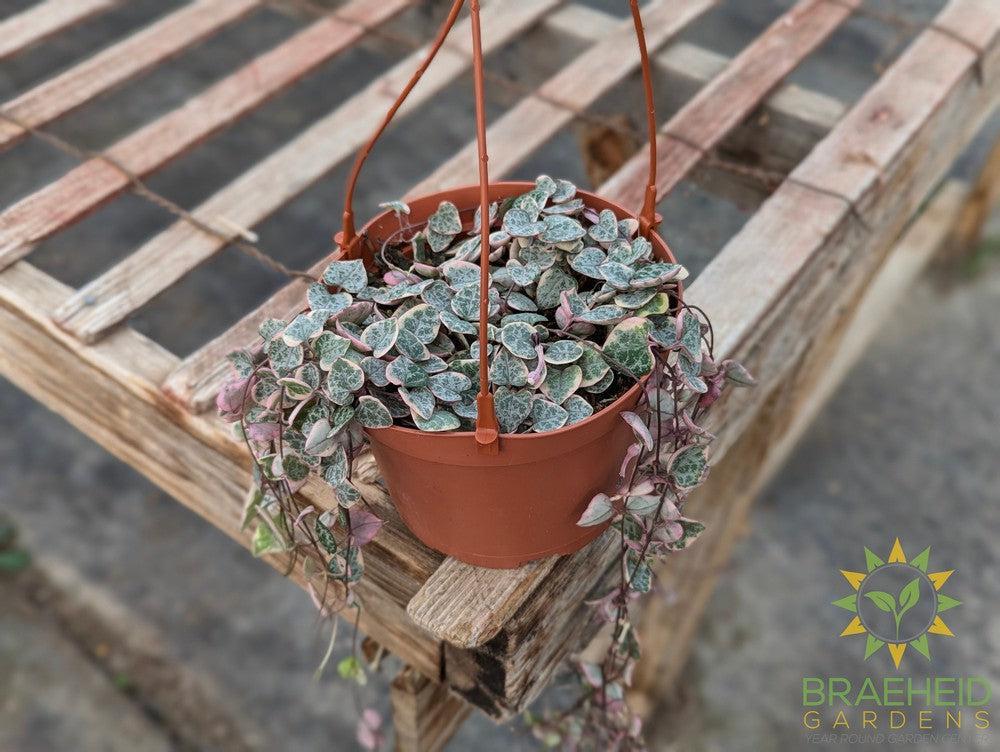
This hanging basket is sold as a variegated string of hearts. Like other Ceropegia, they belong to the dogbane family (Apocynaceae). University of Wisconsin Extension places string of hearts, Ceropegia woodii, in the milkweed subfamily, and notes it is sometimes classified as Ceropegia linearis subsp. woodii.
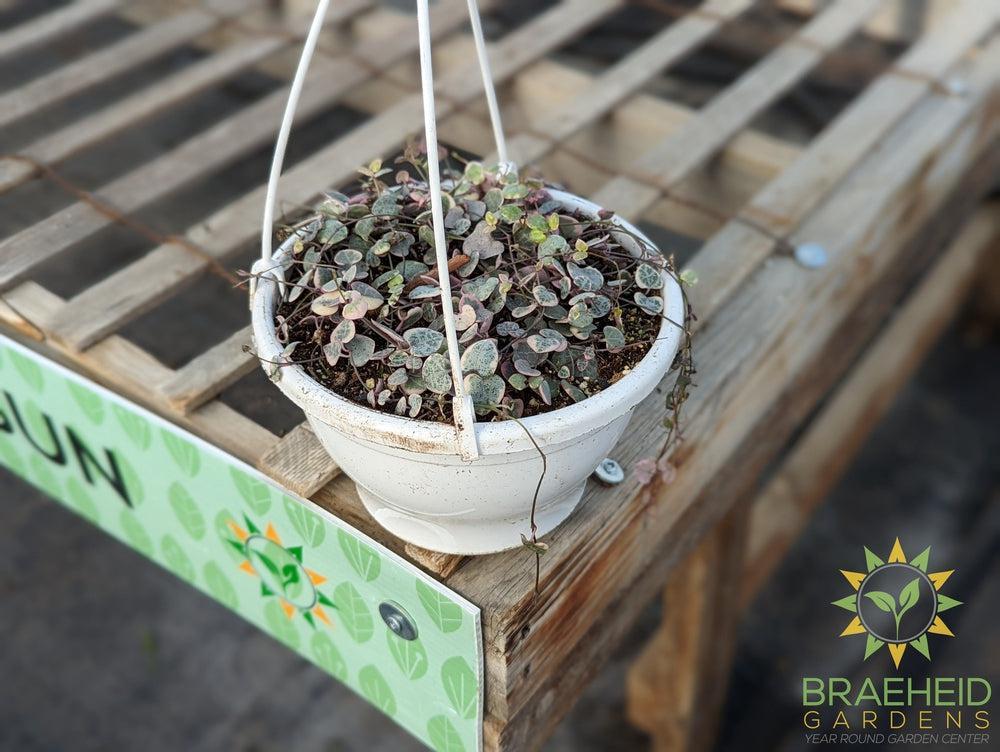
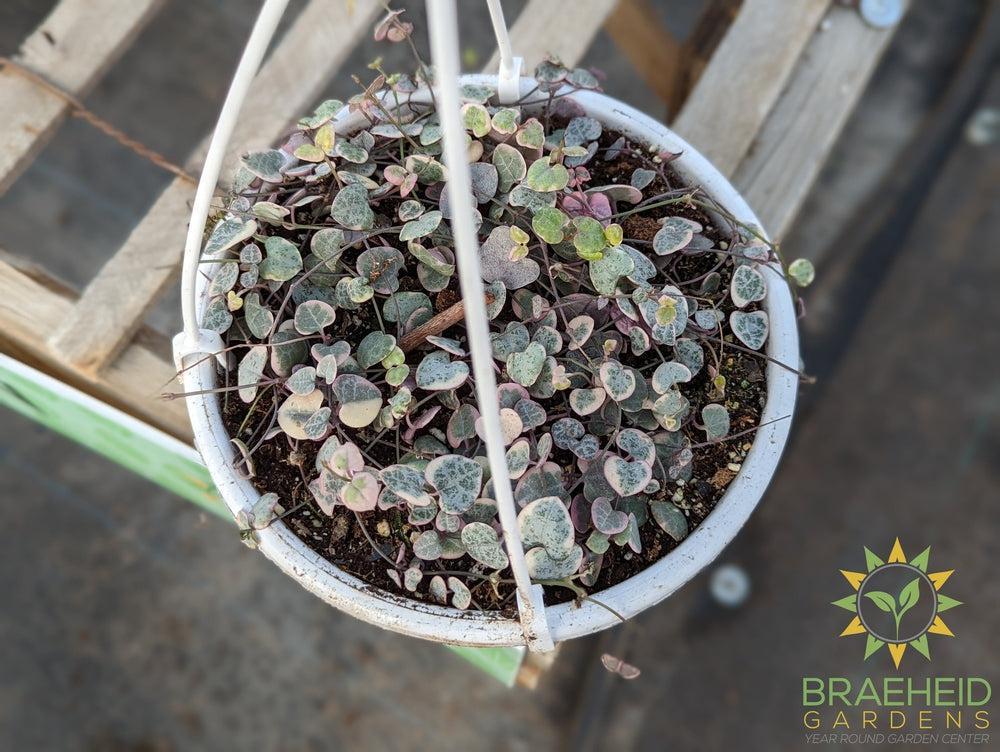
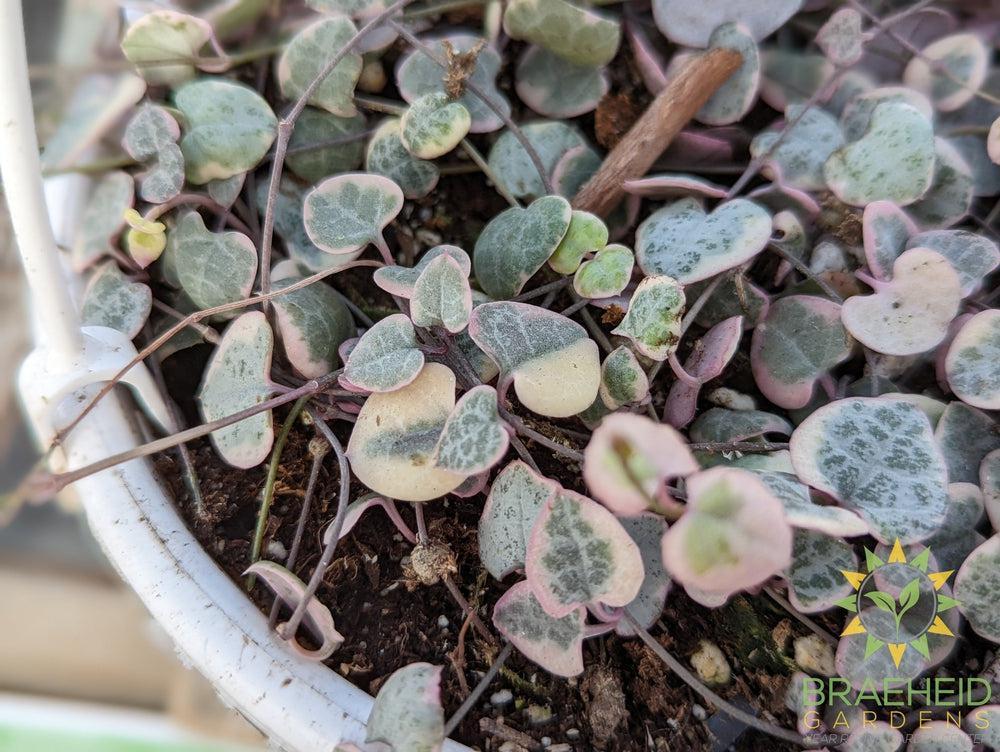
What it is: This listing is sold as a variegated string of hearts (Ceropegia woodii) in a hanging basket. NC State Extension lists f. variegata with cream and pink variegated leaves. The typo tag “veriegated string of hearts” has been left as written.
Light: Give it bright, indirect light so the cream and pink variegation stays clear; University of Wisconsin Extension notes that strong light keeps the silver marbling distinct on the species, and the same idea applies here. A grow bulb helps in our dark winters. Use a well-drained sandy or cactus mix, such as our succulent and cacti soil. NC State Extension lists Ceropegia woodii f. variegata with cream and pink variegated leaves; we have not assigned this listing to a more specific named cultivar.
Watering & care: Allow the mix to dry out completely between deep waterings. It tolerates dry soil much better than a soggy mix, and is easily killed by overwatering (University of Wisconsin Extension). Empty any saucer. NC State Extension likewise says not to overwater, and to let it dry out completely between waterings.
Humidity: This is a succulent grown for bright light and a dryish mix, not for high humidity. Average household air is usually fine; you do not need a humidifier.
Temperature: These are tender houseplants. NC State Extension lists USDA zones 10 to 12. University of Wisconsin Extension says to keep plants above about 15 °C (60 °F) in winter, and to bring any summer outdoor plants in before the first frost. The Royal Horticultural Society rates Ceropegia linearis subsp. woodii H1C (under glass, or outside only in summer). Keep it off cold glass.
Winter indoors: The plant is dormant over the winter: reduce watering even further (NC State Extension), and do not fertilize (University of Wisconsin Extension). The Royal Horticultural Society says to keep plants dry when they are not in growth. Keep it in a bright, reasonably warm window (above about 15 °C / 60 °F) or under a grow bulb.
Expected indoor size: NC State Extension says the wiry stems drape over a container and hang down about 3 feet, and that vines can reach up to 12 feet in their native habitat, which is larger than a typical indoor setting. We are not using that 12-foot figure as an expected indoor length. University of Wisconsin Extension describes trailing branches that can grow several feet long, with leaves about ½ to ¾ inch long and wide. The Royal Horticultural Society lists trailing stems to 1 m or more, with a maximum height of up to 10 cm (the pot plant itself stays low) and a spread of 0.5–1 m (about 20 to 40 inches), reached in about 2–5 years. A hanging basket is often kept in that trailing range; stems can be trimmed if you want a shorter plant.
Feeding: University of Wisconsin Extension recommends fertilizing infrequently, at most monthly when the plant is actively growing, with half-strength houseplant fertilizer, and not at all in winter. The Royal Horticultural Society suggests a low-nitrogen liquid fertiliser two or three times while in growth, and keeping plants dry at other times. Our Cactus Fertilizer used lightly in the growing season is a good starting point.
Pets & pests: We do not have a usable ASPCA plant page for string of hearts or rosary vine (the URLs we checked did not return a plant listing), so we are not calling it pet-safe. It is still a plant, not a snack, and any plant material can upset a pet's stomach. Watch for mealybugs, aphids and scale; overwatering causes root rot and yellow leaves, and wilted leaves can mean it is too dry (NC State Extension).
About your plant: Every plant is a little different. Size, fullness, leaf count and variegation or colouring vary from plant to plant and change with age and light, so we can't promise a particular trailing length, leaf size, variegation or colour. The options listed (6", 8") refer to the pot or container size. They do not guarantee an exact trailing length, leaf size or colour. Photos show typical plants from our greenhouse, not the specific plant you will receive. The shared gallery image shows other Ceropegia as inspiration. Our existing listing noted the beautiful heart-shaped leaves.