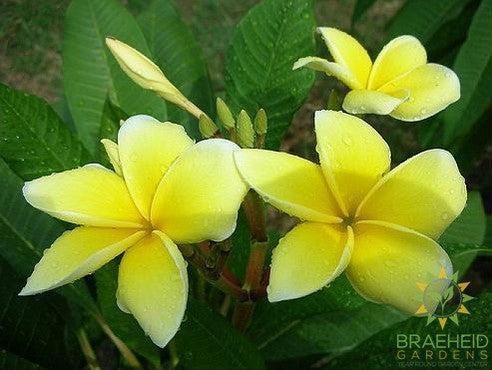
Plumeria Yellow Gold
Plumeria Yellow Gold
Couldn't load pickup availability
Description
Yellow Gold is sold as a plumeria, or frangipani, cultivar. Like other Plumeria, they belong to the dogbane family (Apocynaceae). University of Wisconsin Extension describes plumeria, or frangipani, as tropical American shrubs and small trees grown for their fragrant flowers.
What it is: This listing is sold as plumeria 'Yellow Gold'. We have not confirmed a published profile for this cultivar name on the sources used here, so care follows the genus, with sold-as wording.
Light: Give it bright sun and warmth (University of Wisconsin Extension). The Royal Horticultural Society recommends full light, such as a south-, east- or west-facing window under glass. A grow bulb helps in our dark winters if a sunny window is not enough. Use a coarse, well-draining potting medium, such as a cactus mix or a regular mix amended with pumice, grit or perlite (University of Wisconsin Extension). The Society similarly suggests a well-drained, loam-based mix with extra grit or sharp sand.
Watering & care: Allow the mix to dry out between waterings; do not let it stay soggy, or root rot can follow (University of Wisconsin Extension). The more light the plant receives, the more water it needs. Water moderately when it is in growth, and keep it almost dry in winter (Royal Horticultural Society). Empty any saucer.
Humidity: These plants are grown for sun and a dryish mix more than for high humidity. Average household air is usually fine; you do not need a humidifier for plumeria.
Temperature: University of Wisconsin Extension recommends bringing container plants indoors when autumn nights drop to about 4–9 °C (the 40s °F). The Royal Horticultural Society asks for a minimum of 10 °C (50 °F) and rates P. rubra H1B (under glass, or outside only in summer). Treat it as a houseplant or summer patio plant here, and keep it off cold glass.
Winter indoors: Keep the mix almost dry in winter (Royal Horticultural Society), and reduce watering whenever temperatures are cooler (University of Wisconsin Extension). Do not fertilize out of the growing season (University of Wisconsin Extension). Keep it in your brightest frost-free window or under a grow bulb.
Expected indoor size: University of Wisconsin Extension notes that in warm climates some types can grow more than 30 feet tall, and that Plumeria rubra types can become rangy trees up to 25 feet, which is larger than a typical indoor setting. The Royal Horticultural Society lists a maximum of 2.5–4 m tall and 1.5–2.5 m wide (about 8–13 feet by 5–8 feet) for P. rubra, reached in 10–20 years. We are not using the landscape figures as an expected indoor size. A potted plant is often kept much smaller; the Society says size can be reduced by pruning to a fork in early spring, but wounds can rot, so pruning should be kept to a minimum.
Feeding: University of Wisconsin Extension recommends fertilizing frequently during the growing season with a high-phosphorus (blossom-booster) fertilizer to encourage flowering, and not at other times of the year. The Royal Horticultural Society suggests a monthly balanced liquid feed while the plant is in growth. Use a blossom-booster or a light feed of our Schultz All Purpose Plant Food during the growing season, and ease off in winter.
Pets & pests: The Royal Horticultural Society lists Plumeria rubra as potentially harmful if eaten, and as a skin and eye irritant, for people and for pets; wear gloves when handling. University of Wisconsin Extension notes that the milky sap can irritate the eyes and cause dermatitis in susceptible people. We do not have a usable ASPCA plant page for plumeria, so we are not adding an ASPCA listing. Keep sap and trimmings out of reach of children and pets. Watch for spider mites (these plants are very susceptible), whiteflies and mealybugs (University of Wisconsin Extension); the Society also notes glasshouse red spider mite, and rot in cold conditions.
About your plant: Every plant is a little different. Size, fullness and leaf count vary from plant to plant and change with age and light, so we can't promise a particular stem size, leaf count, bloom or colour. The options listed (4 ") refer to the pot or container size. They do not guarantee an exact stem size, leaf count, bloom or colour. Photos show typical plants from our greenhouse, not the specific plant you will receive. The shared gallery image shows other Plumeria as inspiration. If an order is placed to ship, plumeria will be de-leafed and shipped bare root. It will be up to you to re-root it and push new foliage. This is our existing shipping practice, left as written.