Nepenthes Bloody Mary - Pitcher Plant
Nepenthes Bloody Mary - Pitcher Plant
Couldn't load pickup availability
Description
This listing is sold as Nepenthes 'Bloody Mary'. Like other Carnivorous Plants, they are sold in our Carnivorous Plants collection. They are not all one genus. Venus flytraps belong to the sundew family (Droseraceae). Tropical pitcher plants (Nepenthes) belong to the Nepenthaceae. Sundews are also in Droseraceae. Hardy North American pitcher plants (Sarracenia) belong to the Sarraceniaceae, and butterworts (Pinguicula) belong to the bladderwort family (Lentibulariaceae).
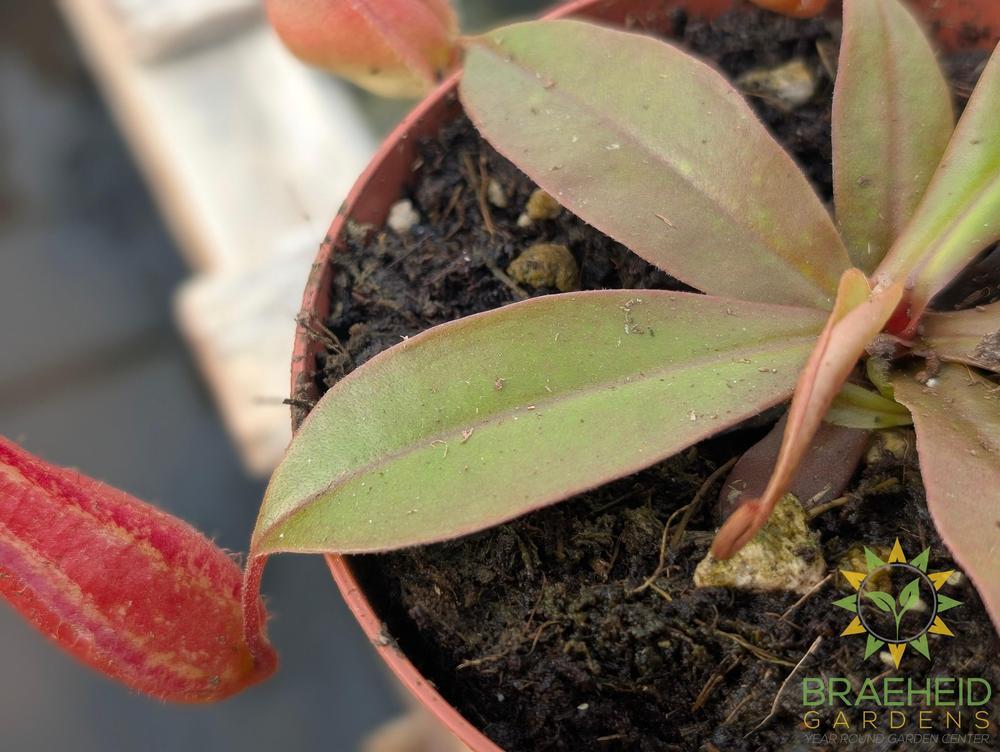
What it is: This listing is sold as Nepenthes 'Bloody Mary'. Clemson Extension lists 'Bloody Mary' as N. ventricosa × N. ampullaria, with small scarlet pitchers, and says it is well suited to terrariums. Care follows tropical pitcher plants.
Light: Give it bright, indirect or filtered light; most tropical pitcher plants can take a little direct sun in the morning or late afternoon (Clemson Extension). A grow bulb helps in our dark winters. NC State Extension recommends bright light and a sphagnum or orchid mix with peat and perlite. Clemson Extension suggests a light, low-nutrient mix such as long-fibered sphagnum or tree-fern fiber with perlite or pumice and orchid bark. Do not use ordinary garden soil (NC State Extension).
Watering & care: Keep the mix moist but well drained, and do not let it dry out (Clemson Extension). Water with rainwater or distilled water when you can; these plants can be sensitive to tap water (NC State Extension). Empty a saucer if the pot would otherwise sit in stale water, but do not let the mix go dry.
Humidity: Clemson Extension asks for humidity above 60%, and NC State Extension notes that pitchers may fail to form or may die back if the air is too dry. A humidifier is a better choice than a pebble tray in our dry indoor winter air. Kitchens and bathrooms can also be more humid rooms, as long as the light is right.
Temperature: These are tender plants. NC State Extension lists USDA zones 10 to 13. Lowland types prefer about 21–35 °C (70–95 °F); highland types prefer warm days of about 21–27 °C (70–85 °F) with cooler nights in the low 60s °F (around 16 °C) (NC State Extension). Many commercial hybrids are more temperature-tolerant than the species (Clemson Extension). Keep it off cold glass.
Winter indoors: Keep it warm, bright and evenly moist in winter. The Royal Horticultural Society rates Nepenthes alata H1A (under glass all year, minimum above 15 °C / 59 °F). Do not give it a cold winter rest.
Expected indoor size: Clemson Extension gives a typical size of about 2 to 3 feet tall and 1 to 2 feet wide, and notes that height and spread vary a lot by species: the smallest may reach only about 3 inches across, and the largest can exceed 1 metre. A potted or hanging plant is often kept smaller. NC State Extension mentions some species, such as N. gracilis, as trailing 6 to 20 feet in the landscape; we are not using that landscape length as an indoor size.
Feeding: Do not use a regular houseplant fertilizer, and do not feed the plant meat; NC State Extension notes these plants do not digest protein that way. If it is not catching insects, Clemson Extension and NC State Extension allow a dilute organic feed (such as fish emulsion, seaweed or kelp extract) during the growing season. Clemson Extension suggests about one-quarter of the usual strength, applied to the leaves and open pitchers, about twice a month in growth.
Pets & pests: NC State Extension tags Nepenthes as non-toxic for cats and dogs, and Clemson Extension lists tropical pitcher plants as pet-safe. We do not have a separate ASPCA plant page for Nepenthes, so we are not adding an ASPCA listing. It is still a plant, not a snack. Watch for aphids, mealybugs, thrips and scale; poor air circulation can invite fungal problems (NC State Extension). Individual pitchers naturally brown after a few months and can be trimmed off (Clemson Extension).
About your plant: Every plant is a little different. Size, fullness and leaf count vary from plant to plant and change with age and light, so we can't promise a particular trap or pitcher size, leaf count or colour. The options listed (4") refer to the pot or container size. They do not guarantee an exact trap or pitcher size, leaf count or colour. Photos show typical plants from our greenhouse, not the specific plant you will receive. The shared gallery image shows other Carnivorous Plants as inspiration.