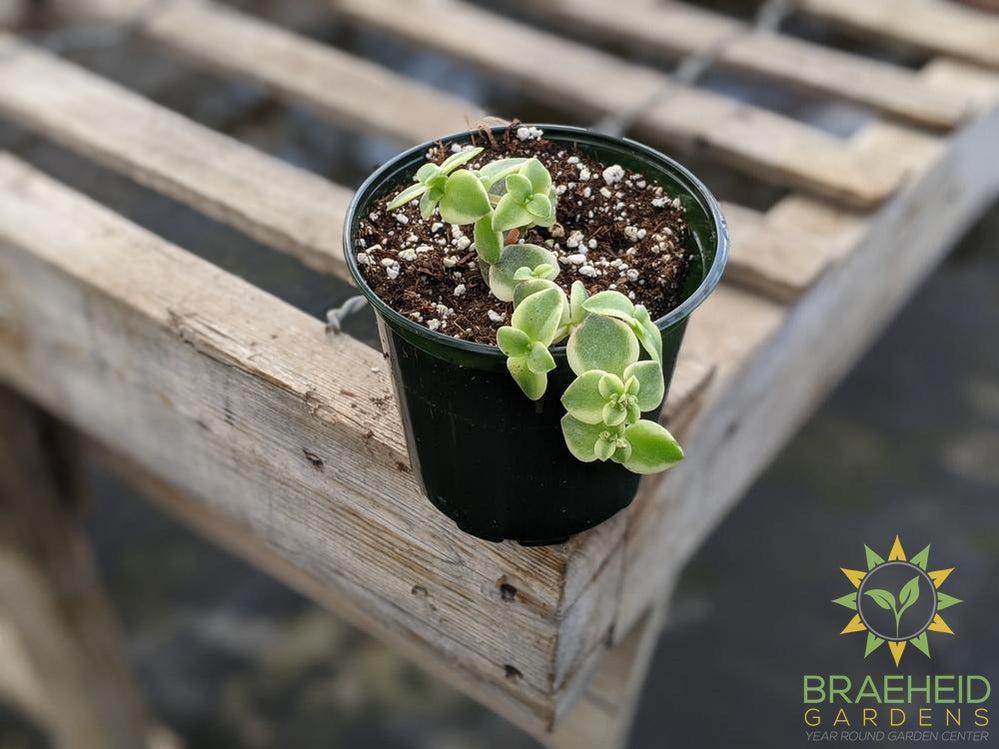
Crassula 'Pellucida Variegata'
Crassula 'Pellucida Variegata'
Couldn't load pickup availability
Description
This variegated Crassula pellucida has small, trailing leaves marked with cream, green and pink. Like other Crassula, it is a succulent in the stonecrop family (Crassulaceae), a group of mostly South African plants that are popular, long-lived houseplants (NC State Extension; Clemson Cooperative Extension).
What it is: This listing is a plant sold as Crassula pellucida variegata (often called calico kitten).
Light: Clemson Cooperative Extension suggests full sun or the bright, filtered light of a south-facing window, with four or more hours of direct sun a day when you can give it. NC State Extension also calls for bright light, with a little afternoon shade. In our dark northern Alberta winters, a grow bulb in a lamp helps. Too much harsh midday sun can scorch the leaves (NC State Extension).
Watering & care: Plant it in a very well-drained mix such as our succulent and cacti soil. Clemson Cooperative Extension says to keep the mix moist but not wet while the plant is growing in spring and summer, then let it dry between waterings in winter; letting it go bone-dry for too long can cause leaf drop. Water thoroughly, then wait until the mix has dried. Overwatering or a heavy mix can cause root rot (Clemson Cooperative Extension). NC State Extension likewise advises watering when the soil is dry and cutting back from fall to late winter. Try not to splash the leaves (Clemson Cooperative Extension).
Humidity: Average household humidity is fine. NC State Extension notes that jade is not fond of high humidity, so the usual issue is overwatering rather than dry air.
Temperature: Clemson Cooperative Extension suggests about 18–24 °C (65–75 °F) during the day and cooler nights around 10–13 °C (50–55 °F). Keep it away from drafts and don't let the foliage rest on cold window glass, especially in winter (Clemson Cooperative Extension). It can't take frost.
Winter indoors: In winter, water less often and let the mix dry between waterings (Clemson Cooperative Extension). Keep it off cold glass, out of drafts, and in your brightest window or under a grow light.
Expected indoor size: We don't have a reliable published indoor mature size for this selection from a university extension or similar source. How large yours gets depends on light, pot size and care.
Feeding: Feed with our Cactus Fertilizer during the growing season; Clemson Cooperative Extension suggests feeding a jade about once every three to four months. Ease off in winter.
Pets & pests: We don't have a reliable published toxicity listing for this selection from ASPCA or a university extension, so we aren't making a pet-safety or toxicity claim here. Related jade plants in this genus are listed as toxic by the ASPCA; if you have pets, it's safest to keep this one out of reach as well. Watch for mealybugs, spider mites, aphids and scale (Clemson Cooperative Extension); (NC State Extension).
About your plant: Every plant is a little different. Size, fullness, leaf count and variegation or colouring vary from plant to plant and change with age and light, so we can't promise a particular plant size, fullness, leaf count or colour and variegation. The size option (4") refers to the pot diameter. It does not guarantee an exact plant size or fullness. Photos show typical plants from our greenhouse, not the specific plant you will receive. The shared gallery image shows other Crassula as inspiration.